Apologies Dear Reader, it has been far too long since I last posted here. In fact, I wouldn’t blame you if you have given up completely on ever reading something new here. But I during the #edtech26 conference in Dublin this week I have been reminded of the joy of blogging by 2 stalwarts of the craft – Maren Deepwell and Jim Groom.
As I wait for my (annoyingly delayed) flight home, I see Maren has already published a post about the conference. As I sit and watch fellow travelers queue around me for their flights, I am slowly processing the past 2 days.
Of course the best part of any conference is always the people who are there. It was so lovely to catch up with so many colleagues and friends and meet new colleagues from the ILTA community.
It was refreshing to be at a conference and to speak with colleagues who aren’t all facing restructuring, endless rounds of VS and/or compulsory redundancies. The UK HE sector is a challenging place right now. The contrast between the Irish HE sector and the UK sector is quite stark. However we do all still have a common set of challenges around enhancing learning and teaching, integrating and using technology effectively and enhancing the student experience.
All the sessions I attended were really insightful and I could see many parallels with work I am involved in with UK universities. I was also delighted to be able to present an overview of the Jisc Beyond Blended Programme in a session that was chaired by Fiona Concannon who leads one of our pilot projects at the University of Galway.
The 3 keynotes (Abeba Birhane, Ben Williamson, Felicitas Mcgilchrist) were excellent – and can be viewed here For me they all had a common theme around how future and current narratives of edtech are being shaped and co-opted into all of our lives. They all highlighted key challenges not just facing the edtech and wider education domain, but wider society.
Abeba and Ben focused more on the “big tech” consumerist, market driven, AI centred narratives that are driving the seemingly inevitable narrative around the future of an enhanced AI driven and dominated education sector. One that is based on, well not that much evidence really but a whole lot of hype and a whole lot of money. Education’s market potential is huge – the investment companies are moving in. Their stakeholders don’t really care about quality and human impact as long as the shares are riding high on the stock market.
Felicitas looked at another side of the technology narrative -focusing on some of the narratives around use of technology and levels of anxiety and mental health, particularly in children and teenagers. She reminded us that some of the popular narratives around anxiety are gaining traction and leading to some oversimplified potential solutions such as banning smart phones in schools. The issues are far more complex. She reminded us of alternative, critical, scholarly research around notions of fragility, and the need to remember that fragility is part of being human. We all are all fragile, have moments of doubt about our abilities, are worried about failing. Education based on care – not made up of productivity and efficiency metrics (my words not Felicitas) is what we really need.
The conference was full of stories, ones we tell to each other as well as the “bigger” stories each of the keynotes explored. The whole “big tech” era were are currently living is terrifying. Perhaps I, like the rest of the conference delegates. are all too aware of the dystopian nightmare we seem to be hurtling towards. But there must be some hope . . . and I do think there is.
The debate motion:
Big EdTech is getting worse (exactly as planned)
This motion argues that educational technology has, for the last 25 years, been getting slowly worse. While we often talk about the tools and technologies of EdTech, the reality is that we are almost always speaking of commercial products. As products, they are not designed to be sustainable or equitable, but disposable and expensive.
As time has gone by, EdTech has moved relentlessly towards hosted metered services and away from installable, sustainable software. EdTech has become a tap that drip feeds us its services in billable minutes, words and tokens. Its products’ hype cycles rise as fast as its sustainability declines. We can never have equity with products that are designed to function as desirable educational status symbols rather than tools for human transformation and flourishing.
Along with Gavin Hendrick I was in conference co-chair Kate Malloy’s team opposing the motion. My contribution to the debate was that we needed to be better at creating our narratives around edtech and what our communitie do (“the way in which we think about who we are depends on the stories we tell about who we are” Sharon Blackie, Wise Women, 2024) and getting them adopted by our senior management. We need to be articulating in a more compelling way than the ‘big tech bros” what a university is for (We need to be able to articulate an understanding of what universities are for that is adquate for our time if we are to be able to decide what to do” Stefan Collini. 2017 Speaking of universities. I did feel quite a lot of pressure during my 4 minute section. So I will try and write another post about the it I know I did rush that perhaps one narrative to develop was to expand on the notions of sanctuary universities. To see if part of our university spaces could supported digital and data sanctuary for our students and staff. Spaces where we could provide equitable alternatives, systems that weren’t tracked, spaces where tech would only be allowed if it were completely transparent and for example shared all its algorithms, allowed them to be critiqued. However despite the far more articulate efforts of my team mates, we narrowly lost the motion.
It was a really enjoyable, thought provoking and fun conference. So huge thank you to all at ILTA for the organisation, to Kate and Rob for co-chairing so well and including me as one of the invited speakers.
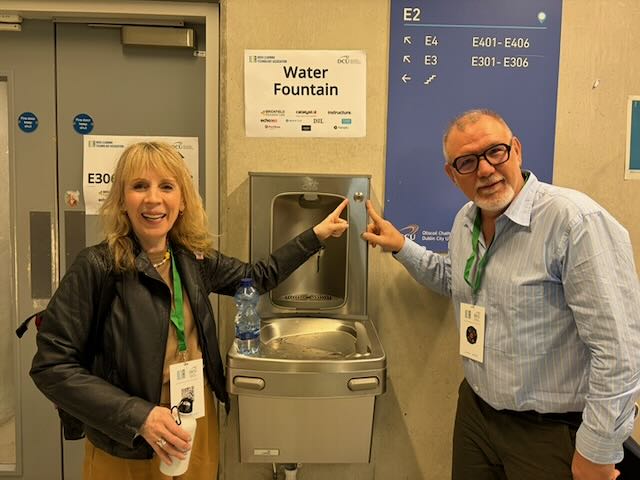
However, I am saving the best moment for last. It was so lovely to catch up with Jim Groom in person. Only Jim would hire a table top pac-mac console for their company “stand”. This retro fabulousness was positioned beside a wall mounted water fountain which I really couldn’t figure out how to work properly – so I was just using the lower (mouth jet) to fill my bottle, until a lovely new colleague wandered, placed his bottle in the “bottle space”, pressed what I had assumed was a button that needed a key or key fob and hey presto the water came out. It was a bit of a “mind blown” moment that had Jim and I in stitched laughing, particularly as our new friend said he had done the same as us until someone showed him “the way”. The joy in helping others for the next few minutes was, well at one point almost a business plan, but certainly had the potential for a new conference ice breaker.
Water cooler moments, they are still the best . . .
Good stuff Sheila, glad you got a boost out of the conference. Your summary is a good share as well.
I had the radio news on while reading your stuff and lo and behold there was a piece about English universities and the current debate around the value of a ddgree for the job market.
The voice of reason in the interview came out with the classic “university isn’t for everybody”. Where’s Stephan Collini when you need him?
thanks Bill
There’s no giving up reading Sheila, your blog remains in my feed reader, and I am joyed whenever the new post light comes on. I’ve enjoyed vicariously (and jealously) the ITLA conference via Maren, Jims, and now your post. Of course it’s quite far from that being there experience, but it is something.
I get what you are saying about the state of EdTech at the same time, I am not quite sure it is the same edtech that fired my spirits up and sent me somehow luckily to go to a few OER conferences on your island. The big EdTech is a strange monster of scale and power and money, and as you suggest, it seems strange how everything came focussed on Platforms, how much of our own stake we gave up for its allure of convenience, or maybe it ws scale, or whatever.
There’s plenty of the original edtech spirit out there (e,g, the people Jim’s Reclaim Hosting supports), it’s like the old Gibson saying about the future being out there but unevenly distributed.
I’m in it for the joy and the excitement and the stories, like seeing how many experienced educational technologists it takes to fill a water bottle 😉
Thanks for sharing, Sheila! It took me several minutes to figure out the water fountain. And I teach user experience design.